
The Ultimate Guide to Madagascar’s Alley of the Baobabs at Sunset
As the late afternoon heat begins to soften over western Madagascar, a cloud of red dust rises along Route Nationale 8. Ahead, rising straight out of flat rice paddies and sun-baked earth like monoliths from a forgotten world, stand two dozen ancient giants. Their pale, bottle-smooth trunks catch the first amber slant of evening light, glowing copper against a widening sky.
Welcome to the Alley of the Baobabs (Allée des Baobabs)—one of the most surreal and unforgettable sunset experiences on Earth.
Situated about 17 to 20 kilometers northeast of the coastal town of Morondava in the Menabe region, this 260-meter stretch of dirt road has become Madagascar’s defining visual icon. Yet seeing it in person feels worlds apart from a postcard. Between passing ox-carts, laughing children, and towering canopies silhouetted against a burning sky, visiting at dusk is an intoxicating collision of wild nature and everyday Malagasy life.
Here is everything you need to plan an extraordinary sunset visit to Madagascar’s most famous avenue.
Ancient Sentinels: What Makes These Trees So Extraordinary?
The stars of the avenue are Grandidier’s baobabs (Adansonia grandidieri), the tallest and most striking of the six baobab species endemic to Madagascar. Roughly 20 to 25 colossal trees flank the main 260-meter corridor, while another two dozen or so stand scattered across neighboring fields and meadows.
Standing up to 30 meters (nearly 100 feet) tall with cylindrical trunks stretching three meters across, they look almost architectural. Their short, gnarled crowns resemble roots reaching skyward—earning them the playful nickname of “upside-down trees”.
Many of these sentinels are over 800 years old, and they carry a poignant backstory. These trees were never meant to stand alone in open farmland. Centuries ago, they anchored a dense tropical dry forest that blanketed the region. As generations of farmers cleared the surrounding woodland for agriculture and charcoal, the baobabs were deliberately spared. Revered locally as renala (or reniala), meaning “mother of the forest,” they were protected for their spiritual significance as ancestral trees and their practical value as sources of food and shelter.
Recognizing the fragile beauty of this surviving grove, Madagascar granted the site temporary protection in 2007 as the nation’s first Natural Monument, followed by full protected status in 2015. Today, the Malagasy conservation NGO Fanamby oversees the protected zone, running a nearby nursery to safeguard young baobab seedlings for future generations.
The Sunset Show: What to Expect Minute by Minute
Before you go, it helps to set realistic expectations: the famous baobab-lined stretch itself is quite short. You can easily walk from one end to the other in twenty minutes. The magic of the Alley isn’t about covering miles—it’s about slowing down to watch the light transform the landscape.
- 4:00 PM – 4:45 PM (Arrive Early & Wander): Plan to arrive 60 to 90 minutes before sunset. The tour vans haven’t packed the plains yet, giving you room to wander the red track alongside farmers walking home from the fields and wooden zebu carts rumbling past.
- Golden Hour: Depending on when you visit during the dry season, sunset falls roughly between 5:29 PM (late May) and 6:10 PM (late October), dipping around 5:45 PM in late July. In the final hour of daylight, harsh afternoon glare melts away; the grey bark takes on a metallic sheen and flushes deep copper and orange-red.
- Peak Sunset & Blue Hour: As the sun sinks toward the flat coastal horizon, the giant trunks sharpen into dramatic black silhouettes against layers of tangerine, crimson, and plum. Resist the urge to sprint back to your car the moment the sun vanishes. Staying an extra 15 to 20 minutes into blue hour brings cooler pastel tones and quiet calm as crowds disperse. (Just aim to head back to Morondava shortly after twilight, as driving rural roads late at night is discouraged for safety reasons.)
Insider Secret — Don’t Sleep on Sunrise: Sunset delivers the richest fire-lit colors and liveliest atmosphere, but it is also the busiest hour of the day. If you have two days in Morondava, visit again at dawn. Watching soft pink morning light break through cool mist drifting across the rice paddies—with only a handful of travelers and local ox-carts stirring—is deeply atmospheric.
Best Time of Year to Visit
Timing your trip around Madagascar’s seasons makes a dramatic difference in both sky conditions and road access:
- Dry Season (May to October — Peak Beauty & Reliability): This is prime time for western Madagascar. Skies are reliably crisp for vivid sunsets, the red dirt road is firm and passable, and surrounding attractions like Tsingy de Bemaraha are open. Notice that during these dry months, the baobabs shed their leaves, leaving their iconic sculptural branches bare against the sky. July through September brings the most dependable weather—along with the biggest crowds.
- Shoulder Months (April & November): Great transitional windows with warm temperatures, fewer visitors, and mostly manageable road conditions, though late November can bring early showers.
- Rainy Season (December to March): The baobabs sprout lush green crowns, and temporary rainwater pools sometimes form alongside the road—creating breathtaking mirror reflections of the trees. However, torrential downpours turn the unpaved RN8 into deep, slick mud that strands standard vehicles and closes regional parks. If traveling in the wet season, a true 4WD vehicle and experienced driver are non-negotiable.
How to Get to the Alley of the Baobabs
Almost every traveler uses Morondava as their home base. A laid-back seaside town hugging the Mozambique Channel, it offers beachfront bungalows along Nosy Kely, vibrant markets, and fresh grilled seafood.
Step 1: Getting from Antananarivo to Morondava
- By Air (Fastest & Easiest): Madagascar Airlines operates direct domestic flights from Antananarivo’s Ivato International Airport (TNR) to Morondava (MOQ) in just 1 hour and 5–10 minutes. Flights typically run 5 to 10 times a week depending on the season—not always daily. Because domestic schedules in Madagascar can shift, book early during peak months (July–October) and build a buffer day into your itinerary.
- By Road (The Scenic Overland Trek): If you want to watch Madagascar’s central highlands gradually melt into dry western plains, you can drive roughly 650 kilometers via the RN7 south to Antsirabe, then west along the RN34 and RN35 through Miandrivazo. With a private car and driver, most travelers split the 12+ hours of driving across two days with an overnight stop. Budget travelers can catch long-distance taxi-brousses (such as Cotisse or Soatrans), though trips often stretch 12 to 16 hours. Whichever option you choose, avoid traveling on highways after dark.
Step 2: Getting from Morondava to the Alley
The final 17–20 km stretch along the rutted, dusty RN8 takes 30 to 40 minutes.
- Private Taxi or Driver: The easiest choice. Negotiate a round trip that includes waiting time through sunset. Expect to pay roughly 50,000 to 100,000 MGA (Ariary)—politely walk away from quotes above 150,000 MGA.
- Guided Excursion: Booking through your Morondava hotel or a local tour agency pairs transport with storytelling about Sakalava traditions and nearby hidden trees.
- Budget Route (Taxi-Brousse + Tuk-Tuk): Take a shared van headed toward Belo-sur-Tsiribihina (roughly 10,000–20,000 MGA), hop off at the Marofototra junction, and take a local tuk-tuk (or walk in the heat) for the remaining 6 kilometers.
Entry Fees & Hours
Because the trees border a public road, pedestrian access is free and open 24/7. Vehicles entering the designated dirt parking area pay a small local fee of 2,000 to 5,000 MGA in cash.
Photographer’s Playbook: Capturing the Shot of a Lifetime
Even with a smartphone, it’s hard to take a bad photo here—but a few deliberate choices will elevate your images from tourist snaps to gallery-worthy frames:
- Drop Low & Go Wide: Get close to the ground and use a wide-angle lens (16–35mm) to exaggerate the monumental 30-meter height and sweeping radial branches.
- Walk Beyond the Parking Area: Most visitors cluster right near the main parking lot and craft stalls. Walk 100 meters further down the road or step carefully along the dusty edges of neighboring paddies (never trample crops) to find uncluttered angles where vehicles vanish from your frame.
- Include Human Scale: A solo traveler, a child with a bicycle, or a passing zebu cart silhouetted beneath the trunks instantly conveys how impossibly massive these trees really are.
- Bring a Sturdy Tripod: Essential once the sun dips below the horizon for crisp blue-hour shots—and if you stay for clear-sky astrophotography under western Madagascar’s dark skies.
- ⚠️ Leave the Drone at Home: Do not assume you can launch a mini-drone for an aerial sunset shot. Under Madagascar’s strict RAM 10000 aviation regulations (enforced across 2025–2026) and protected-area laws, every drone flight—including recreational drones under 250g—requires prior government permits from both Aviation Civile de Madagascar (ACM) and regional environmental authorities. Flying without permits at the Alley of the Baobabs is prohibited, and undocumented drones risk confiscation at airport customs.
Don’t Stop at One Road: Nearby Wonders to Pair With Your Visit
Since the Avenue itself only takes an hour or two, turn your trip into a richer western Madagascar adventure:
- Baobab Amoureux (Lovers’ Baobab): Just 7 km northwest of the main avenue, two intertwined Adansonia za baobabs twist together in an eternal embrace. Local folklore tells of two young lovers from rival villages forbidden to wed. It’s a quick 15-minute detour—ask your driver to stop on the way.
- The Sacred & Hollow Baobabs: Ask a local guide to introduce you to other remarkable specimens nearby, including the revered Sacred Baobab and a massive Hollow Baobab you can actually step inside.
- Kirindy Forest Reserve: About 50 km north (around an hour’s drive), this dry deciduous reserve is one of the best places in the country to spot Madagascar’s elusive top predator, the fossa, alongside dancing Verreaux’s sifakas, brown lemurs, and tiny nocturnal mouse lemurs. Many travelers spend the day in Kirindy and time their drive back to hit the Alley right at sunset.
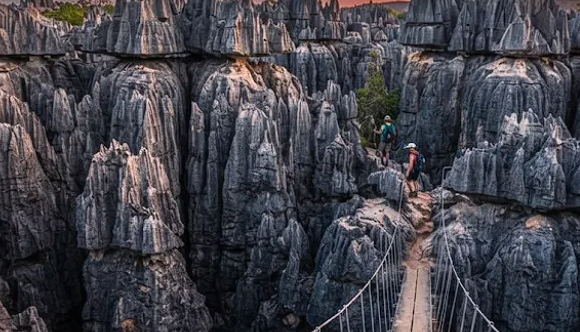
- Tsingy de Bemaraha National Park: If you have three to four extra days during the dry season, push north on a rugged 4×4 expedition (8–9 hours including river ferry crossings via Belo-sur-Tsiribihina) to hike and climb through jagged UNESCO-listed limestone “stone forests”.
- Belo-sur-Mer: South of Morondava, this peaceful coastal village is famous for shipwrights crafting traditional wooden sailing dhows right on the sand.
Quick Field Checklist & Responsible Etiquette
A few small preparations will keep your evening comfortable—and ensure your visit benefits the community protecting these trees:
- Apply Mosquito Repellent Before Sunset: As soon as the sun begins to dip, mosquitoes swarm out of the surrounding rice fields. Spray up before you leave your vehicle so you aren’t swatting while framing your shot.
- Use the Restroom in Morondava: There are no formal public toilets at the Alley. Plan accordingly before leaving town.
- Pack a Headlamp: Rural Madagascar gets pitch black quickly after twilight; a headlamp makes walking back to your car stress-free.
- Carry Small Ariary Bills: Useful for the parking fee, bottled water, handmade wooden baobab carvings from friendly local artisans, or supporting Fanamby’s conservation work.
- Ask Before Shooting Portraits: The avenue is a living village thoroughfare, not a movie set. Always ask permission with a warm smile before photographing local residents or ox-cart drivers, step politely out of the way of oncoming taxi-brousses, and pack out everything you bring in.
The Final Glow
Long after the dust settles on your shoes and the last embers of twilight fade behind Morondava, the image of the Alley of the Baobabs lingers. Watching these 800-year-old “mothers of the forest” stand watch over a glowing African sky is more than a bucket-list photo op—it is a quiet, humbling reminder of what endures when humanity chooses to revere nature rather than erase it.